Focus - Attention and Savouring Life
(click on images to view them full size)
Pay attention!
How many times have we heard this phrase as we were growing up - attending a boring event or classes at school. I’ve just finished reading a book titled Rapt by Winnifred Gallagher and I must say that it has been very impactful and not really what I expected. That’s a great combination in my mind and it makes it easy to recommend this book for those interested in attention or living a more focused life.
Early in the book is a quote by Ellen Langer who says that “the term mindfulness wouldn’t be necessary if most people didn’t have such an impoverished, static understanding of what ‘paying attention means’.” Let me start off by saying that I am rather envious of Langer’s ability to put together words and the way she turns a phrase - it tickles my brain.
It also got me to thinking what is meant by paying attention? I know that when I first think of that phrase it conjures up memories of strict admonishments to sit still - quite fidgeting and basically rivet your attention on something. Gallagher says that most people equate paying attention with “trying to hold it still and studying it” which is reflected in that static and unyielding image of attention. When I think back to my much younger self - there is no way that approaching it in that way would yield anything other than growing bored and ending up fidgeting.
In fact researchers have found that in order to better pay attention to something we should approach it with curiosity and playfulness - making a game out of trying to understand and unravel it - whatever it is will hold our attention far longer than trying to fixate on it.
Multiple image compositions make it difficult to achieve focus on any one thing. (EXIF data 3 images merged in camera 120mm, f22, 1/6s, ISO64, 6 stop ND filter)
That makes sense to me. I recall sitting through some less than riveting lectures when I was at university (why did I take Astrophysics?) and it was only by turning the lecture subject into some sort of a game that I was able to avoid the dreaded head bob of falling asleep. Granted sometimes counting the number of times a prof said a certain word or snapped a piece of chalk (as in an infamous Calculus class) was not the most productive way to retain the material being presented, but I digress.
The main point I’m making is that when we get creative and really try to be curious about something - our attention is likely to be focused for longer periods of time and we might actually learn something too.
I’ve heard of a photography assignment that Freeman Patterson favours in one of his Design workshops. Participants are given a location and told not to move more than a few feet in any direction for the 45 minutes of the exercise. In that time they are to produce 10 or more creative images incorporating the elements of design that have been discussed in the workshop. Now this may seem like an easy assignment, but if your point of view is a dumpster or a building’s air conditioning unit - it might be a bit more challenging than you thought.
Learning was fun during our Haida Gwaii trip when Danny Katt explained many of the things we were seeing and turned it into a daily game for us to replay what we’d learned. (EXIF data 120mm, f5.6, 1/250s, ISO800)
Initially there is resistance in the mind - how am I going to get 1 image let alone 10 from this spot - then there is the bargaining - well I’ll just take some shots which produce lacklustre images (not something you want to share with the group). Finally after a while you focus your mind and your attention and start to make a game out of it - what if I change my perspective or frame it up differently - which leads to this is the essence of what I see - not a dumpster or an AC unit at all, but lines, shape, texture and colour. Suddenly 45 minutes are up and you’re in the flow and not ready to stop.
Rapt attention has resulted in curiosity of the subject and creative ideas of how to deconstruct and photograph the elements in front of you. It’s a very powerful exercise.
I have a personal exercise that I use daily to help train my focus and attention. I read for about 30 minutes each morning and I really enjoy this time as it gets my mind working. I read all sorts of different subject matter and even if it’s not something I’m particularly interested in I make a game out if - I’ll really focus and read this one page today and then I can move onto something more interesting - suddenly I invariably find myself several pages in and fully engrossed in the subject matter.
Wordplay - meaning matters
I’m one who really enjoys understanding where words come from as I think it helps me to explore them further and pull together deeper meaning. A very odd thing happened during one of my morning readings - I was reading Rapt and also Strong Ground (Brene Brown’s book) and both books were talking about attention. Both authors put in a section about the origin of the word attention and the Latin meaning of the word which is to reach toward. Now I love the fact that I came across this on the same morning while reading books that reference each other - there is something serendipitous about this.
When I further ponder the meaning reach toward - it leads me to thinking about anticipation which to me is about the mind reaching toward some future state. This seems to be somewhat opposite from the concept of focused attention which is homing in on something (and yes it is homing in - I have often thought the phrase is honing in, but it actually originates from a reference to homing pigeons).
A favourite activity is taking a backyard safari in any weather to see what I find - house finch all fluffed up against the cold. (EXIF data 600mm, f4, 1/1000s, ISO800)
When you anticipate something it usually has a relatively short shelf life - you eventually stop paying attention to the anticipated thing once you have it and the perceived pleasure to be derived from it dims and becomes an overlooked comfort. For example, I anticipated walking to coffee shops when we moved close to downtown and even to a neighbourhood with a coffee shop within walking distance. In my mind I had woven all sorts of stories of pleasures to be had from the anticipated experiences, but in actual fact when I did live within walking distance of a coffee shop - I rarely went for coffee. It quickly became a comfort that I could experience, but I often overlooked or forgot about it as the anticipation dimmed.
Before we moved to that location I was focused on the pleasures to be had experiencing walking to a coffee shop (ok it’s another fantasy of mine - like the retirement fantasies).
I feel like I’ve shifted my focus to a different place now and I have more appreciation for the comfort stage rather than the anticipation stage. I appreciate knowing that I can go for photo walks in my backyard and see all sorts of birds - in fact I take part in these experiences frequently rather than just anticipating them. Focusing my attention on the doing rather than the dreaming or yearning or anticipating.
The Brain and Focus
In Strong Ground - Brene Brown mentions Jon Kant-Zinn’s definition of mindfulness which is linked to focus and attention. He talks about mindfulness being “awareness that arises through paying attention, on purpose, in the present moment, non-judgementally… in the service of self-understanding and wisdom.” I really like how this touches on the intentionality of the experience as well as the openness to curiosity (non judgement) - being really stuck in the present.
Backlight makes these bullrushes really stand out in the early morning sunlight - their form and texture is really highlighted by the rim light - only noticeable because I was really present in the moment when I saw them. (EXIF data 600mm, f4, 1/600s, ISO400)
It’s interesting to note that in our youth when we have our whole lives in front of us - we’re often (I know I was) focused on the future - what is to come - what hasn’t yet been achieved or how good life will be when….. It’s also interesting to note that when we’re young there seems to be additional focus on the negativity bias that we humans are prone to focusing on - it’s a lot about what we don’t have yet when we’re young and anticipating that time or state of being in the future.
For me - I couldn’t wait to be old enough to be able to drive which might have been associated with the fact that we lived far enough outside of town that there was one bus in the morning and evening - otherwise it was hoping to get a ride from mum or dad. I thought that getting my license would solve all my issues and I’d be able to enjoy all sorts of activities - of course this isn’t the way it worked out as there were a few issues like not having a car or gas money for starters.
As I got older I started to focus less on the future and more on the present moment - really enjoying where I’m at now rather than being stuck in the future or the past. This seems to be pretty typical for most people as they age and start to realize that time is not limitless. Savouring where I am at currently rather than yearning for some future state.
Living a focused life in the present requires balancing all of the various inputs to my life - if my expectation is that it’s about being happy all the time then that would be unrealistic and quite frankly an absurd notion. I read a metaphor about treating your mind as a private garden and being especially choosey about what you allow into the garden. This makes sense to me as introducing weeds or invasive pests can stress, undermine and destroy a garden - much as I see negative newsfeeds doing to many people today. I try to be very selective about what information and inputs I allow into my personal space as negativity seems to be contagious to me.
Macro image of ice crystals on a tree branch remind me of the complex neural patterns in our brains. (EXIF data 105mm, f16, 1/200s, ISO400)
What I pay attention to is where my energy flows - this focus can and does change my thoughts and my behaviour - in fact Daniel Seigel stated this in his book The Whole Brained Child - the neuroplasticity of the brain means that we can continue to reshape and mould our thoughts and neural patterns. It’s in fact never too late to make changes and learn differently - that’s actually what learning is all about - changing your brain and thought patterns through experiences and redirecting neural patterns.
I find this very heartening - I’m not a lost cause or destined to be stuck in thought patterns or behaviours that no longer serve me. I continue to work on shifting my focus to more positive and broadening thought patterns, but I must admit that it is a daily challenge for me. Maybe I should try to make this more engaging and playful as doing so may help to keep my attention on more positive thoughts and activities - playfulness seems to be the hallmark of a focused life.
Savouring the Experience
I really like the phrase that energy flows where attention goes - this is what focus is about to me, but I also found it useful to think of attention like a flashlight beam. I first came across this in a Brene Brown podcast when she was interviewing Dr. Amishi Jha. Dr. Jha encouraged listeners to think of attention like the focused beam of a flashlight where the light is centred on illuminating one thing - you can see it clearly and everything outside of the beam of the light is out of view - this relates to focused attention. When you try to focus your attention on multiple things it’s like using a wide beam flashlight - the light is dispersed and illuminates a wide area, but doesn’t light anything within the beam very well. I imagine my eyes darting around within that broad beam of light trying to interpret what I’m seeing - not really able to focus clearly on any one thing. This highlights for me how ineffective multitasking is, but I digress again.
Focused attention really is the link and connection between goals or aspirations and personal energy or abilities. When I’m able to home in on the goal and really focus attention on that objective while suppressing the intrusion of any distractions then I am much more able to be successful and complete my goal. I am able to stay focused on reaching my goal.
More so than being able to successfully complete a goal, focused attention allows me to really pay rapt attention to the present and experience things fully. In effect this is the ability to savour the moment. To linger and really explore and appreciate the moment.
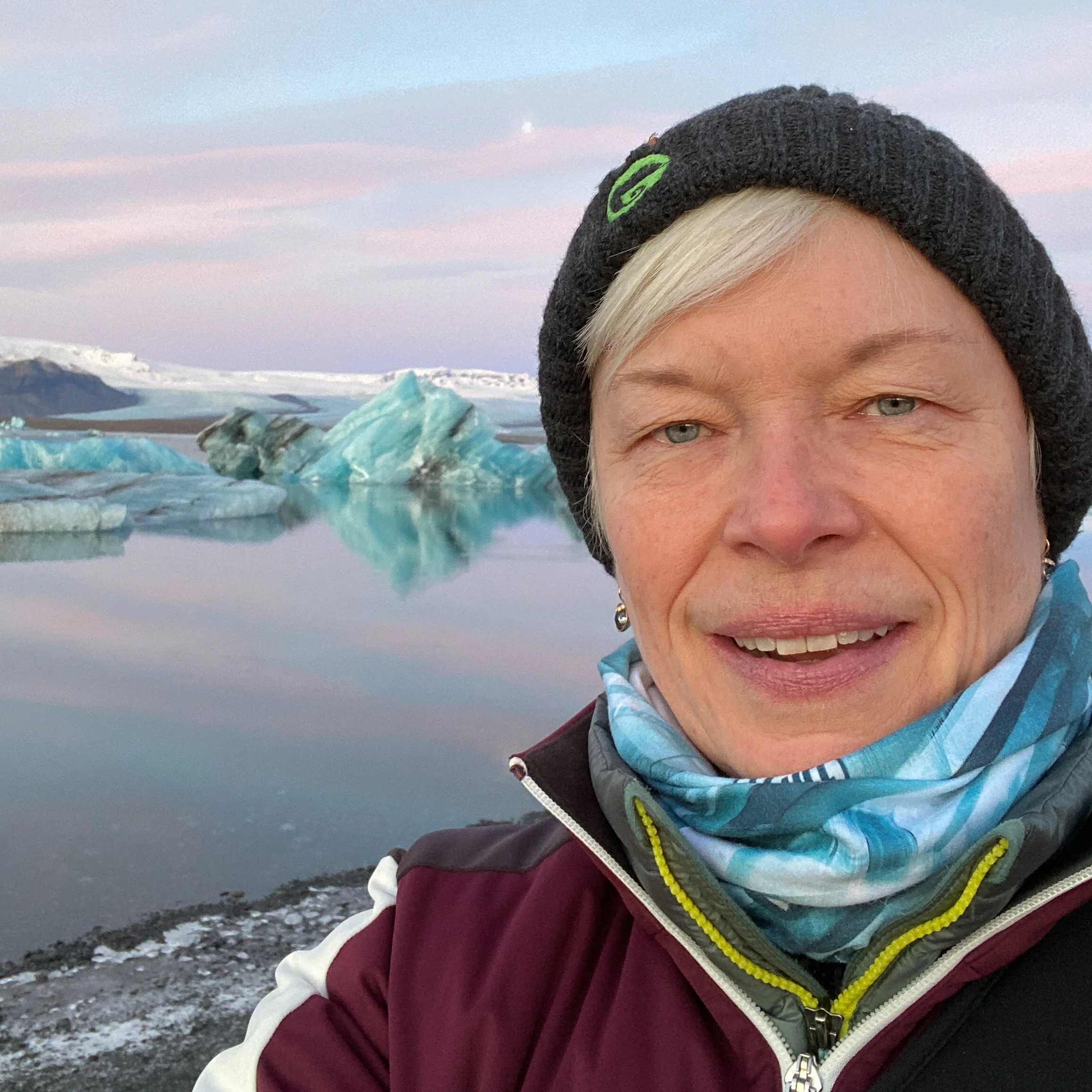
A very memorable sunrise over the glacier lagoon in Iceland during my visit in 2022. (EXIF data 24mm, f16, 1/100s, ISO400)
Savouring or paying rapt attention is more about how I approach something or even what my mindset is rather than the situation. For example, savouring a sunrise for me is about really seeing the colours and how the partial cloud cover results in even more magnificent colour display versus focusing on the presence of cloud cover and the possibility of rain. It really puts a damper on the sunrise.
You see what you look for and you can train yourself to look for and savour the positive instead of passively waiting for it to discover you or even focusing on the negative and totally missing the positive moment altogether. In fact the greatest obstacles to being able to savour the moment is either not paying attention to them (missing them) or feeling pressed for time and not allowing yourself to linger over them (rushing the experience or even FOMO - fear of missing out so rushing on to the next experience).
Pulling it all together
Well once again this post has not turned out the way I envisioned it would - I feel like my mind went a bit all over the place rather than meandering along a well thought out and focused path (couldn’t resist that one). Sometimes that is just the way my writing seems to unfold. One thing I do know though is nothing is as important as I think it is when I’m focusing on it - that laser focused attention raises it (whatever it is that I’m focused on) up to an elevated level for even a short time.
My challenge is to know when to let go of focus and reset my attention to something new or different that catches my eye. I find that my photography allows me to practice this and hopefully develop a skill that transfers over into my day to day life.
Do you have any difficulty staying focused on something? Any tips or tricks for maintaining focus? I’d love to hear about it in the comments below or drop me a note by clicking on the Connect With Me button.
Focused attention brings out the texture and highlights of this snail crawling along a hosta plant stem covered in dew in the early morning. (EXIF data lensbaby Velvet85mm lens, f4.5, 1/80s, ISO400).
I hope you’ll come back soon, share a cuppa, relax and enjoy more of my musings.